Pull requests stall when approvals are manual
Reviewers juggle compliance checklists, risk sign-offs, and flaky CI. Releases slow to a crawl the moment teams grow.
For regulated teams
Mergebot automates policy-aware review, risk scoring, and CI/CD integration so every merge is audited, explainable, and fast enough to keep shipping on schedule.
for policy-approved PRs
with hybrid AI + human routing
export-ready evidence packages
Queue intelligence
AI copilots summarize each PR, predict risk, and recommend the fastest path to merge.
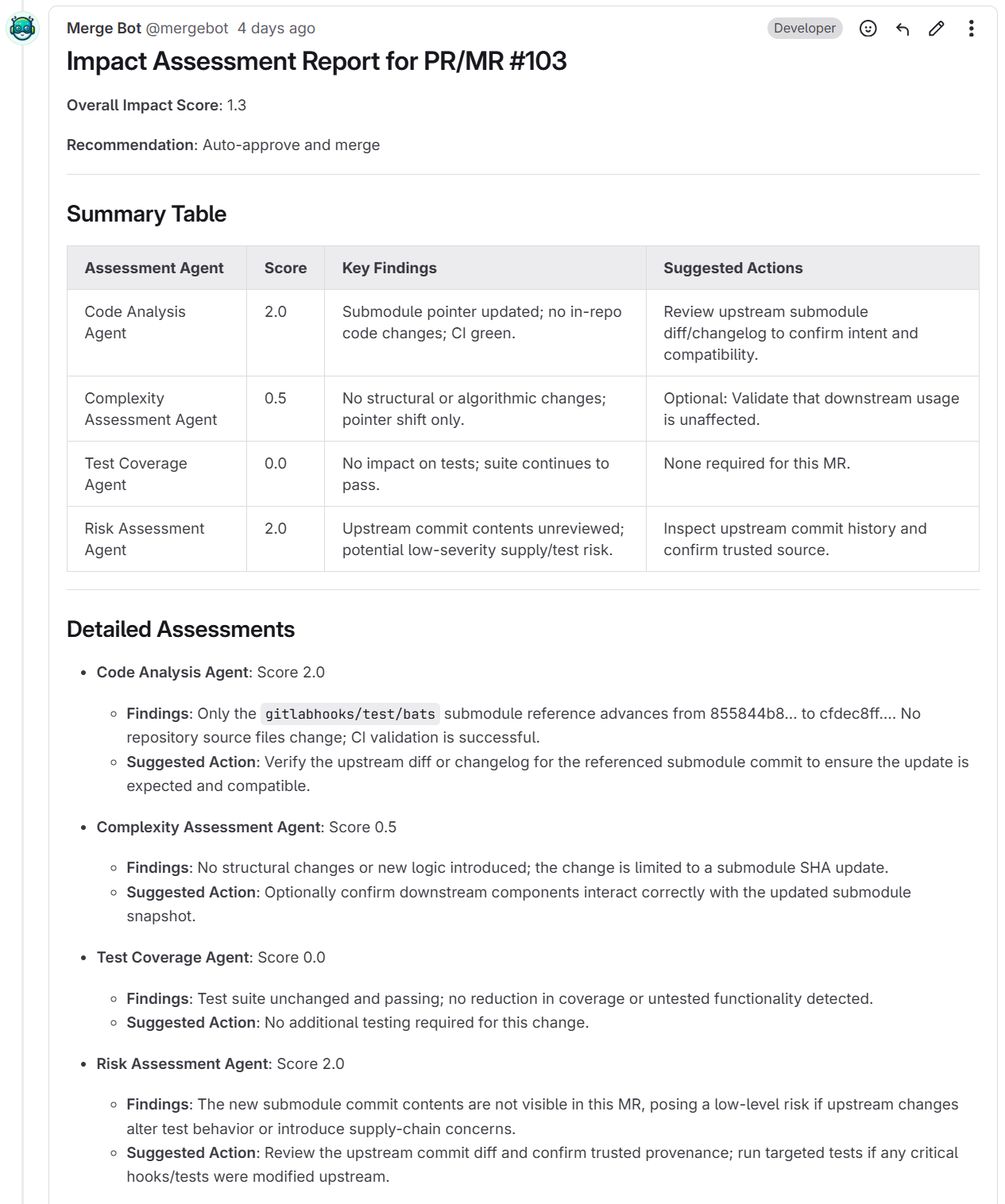
Automated checks
Next actions
Queued for merge once policies and human overrides reconcile.
Compliance teams use Mergebot to codify separation-of-duty rules, keep merge evidence tamper-evident, and share queue status with auditors in minutes.
Why teams switch
Compliance-heavy teams reduce review toil, remove merge queues, and capture defensible evidence with Mergebot. Start with templates or import your existing policy.
Reviewers juggle compliance checklists, risk sign-offs, and flaky CI. Releases slow to a crawl the moment teams grow.
Paper policies rarely map to what happens in Git. Teams rely on memory to recall reviewers, approvals, and coverage gates.
Screenshots, Slack receipts, and spreadsheets form the “evidence.” When a regulator asks for proof, the scramble begins.
How Mergebot responds
Define policies once, then let Mergebot orchestrate reviews, testing, and approvals while humans focus on the changes that matter.
Declarative YAML rules capture every conditional approval, separation of duties, and risk threshold.
Agents read diffs, test output, coverage, vulnerabilities, and dependencies as a single set of signals for reviewers.
Risk-scored queues merge safe work immediately and flag edge cases for human sign-off with full trails and exports.
Feature spotlight
Mergebot unifies signals from code, tests, infrastructure, and policy engines into a single approval surface.
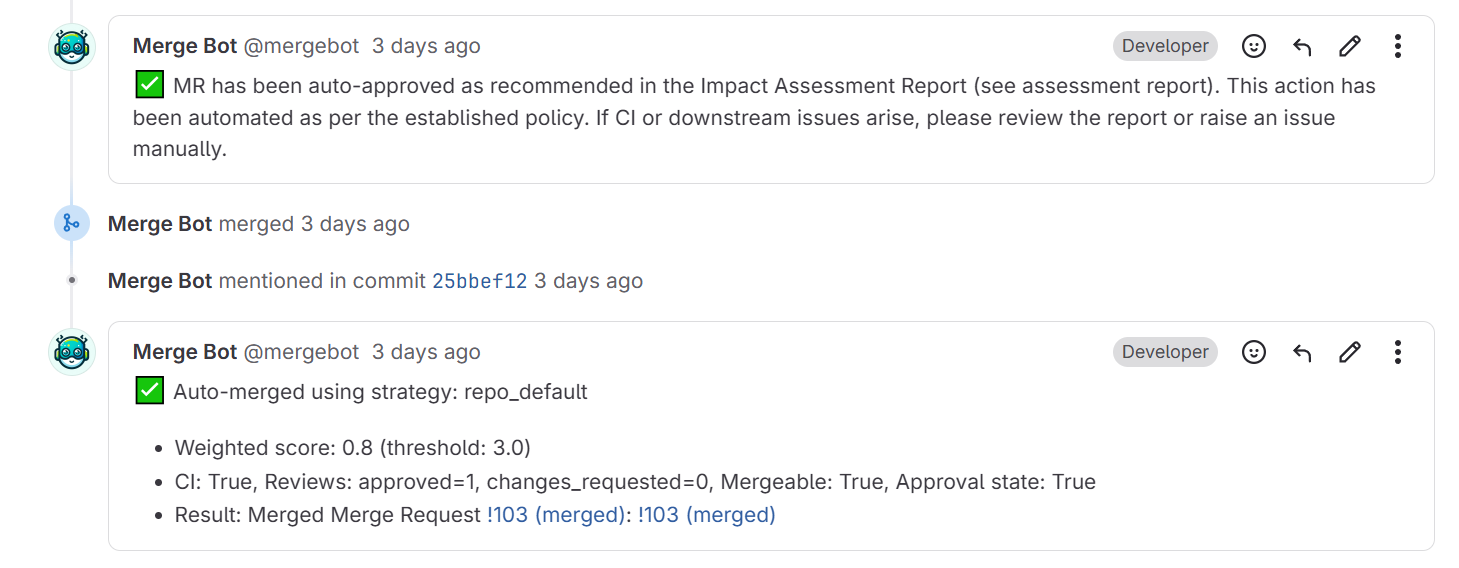
Evaluate every diff with code coverage, dependency impact, and historical incidents to route to the right queue.
Mix GitHub and GitLab repos with unified routing, approvals, and policy inheritance from one control plane.
Exportable audit reports signed with merge metadata, reviewer identities, and CI proofs.
SOC2, SOX, and ISO-ready policy blueprints help you start fast with controls your auditors recognize.
Automatically open incidents or dispatch runbooks when policies fail or risk thresholds spike.
Blend AI recommendations with human checkpoints, including emergency brakes, manual overrides, and coverage escalations.
Merge orchestration blueprint
Each step keeps humans focused on intent while Mergebot automates the rest. Visualize the workflow from install through continuous audits.
Authorize the Mergebot GitHub or GitLab app and select repos. SOC2-ready scopes keep code secure.
Start from proven templates—coverage, approvals, change risk—or map your own rules in minutes.
Agents analyze diffs, tests, ownership, and infrastructure impact; humans intervene only where needed.
Every merge is queued, signed, merged, and archived with downloadable reports for audits or retros.
Merge orchestration stream
Signals travel across Mergebot’s pipeline. Each lane automates policy checks, AI review, and final queue actions without breaking compliance.
Signals captured instantly
Controls applied
Context for reviewers
Delivery orchestrated
Use cases
Regulated CI, digital health, platform engineering, and open-source maintainers all rely on policy-aware automation. Each scenario keeps humans in control while Mergebot carries the overnight load.
AI-led risk scoring, compliance test suites, and directory-specific approvals let regulated teams auto-clear safe work and queue critical changes for daytime review.
Capture reviewers, policy diffs, and test outputs automatically so exports satisfy HIPAA, FDA, and FedRAMP audits without spreadsheets.
Differentiate routine fixes from invasive refactors. Mergebot merges low-risk code in minutes and blocks high-risk changes until owners weigh in.
Declarative policies enforce scalable governance. Contributors get instant feedback while maintainers rely on queue intelligence and risk scoring.
Security & compliance
Bake your deployment policies directly into the merge pipeline. Every merge is evaluated, queued, and approved against the controls that keep you compliant.
Policy playbook
approval_policy:
  threshold: 3.0
  weights:
    CodeAnalysis: 0.4
    ComplexityAnalysis: 0.2
    TestAnalysis: 0.2
    RiskAnalysis: 0.2

merge:
  enabled: true
  threshold: null
  strategy: repo_default
  rules:
    ci_passed: true
    ci_strict: false
    no_changes_requested: true
    mergeable: true
    approval_state: true
    branch_prefixes:
      - "feature/"
      - "bugfix/"
Ships with Mergebot today. A balanced mix when compliance and developer productivity share the same priority.
Why Mergebot wins
| Capability | Mergebot | Manual orchestration |
|---|---|---|
| Policy automation | YAML-backed policies across repos, services, and risk profiles with inherited defaults. | Tribal knowledge, unchecked config drift, one-off conditionals in each PR. |
| In-flight visibility | Live merge queue with risk scoring, reviewer SLAs, and AI generated summaries per change. | Spreadsheet trackers, stale dashboards, and manual pings for every critical fix. |
| Audit evidence | Signed approval logs, exports to CSV/JSON, and SOC2-ready trails per merge. | Screenshots, chat threads, and missing context when regulators request proof. |
| Delivery speed | Safe merges in minutes—even overnight—without bypassing gates. | Wait for humans in every time zone; changes snowball into release trains. |
Teams in production
From fintech core banking to digital health, Mergebot keeps regulated teams shipping continuously.
“Mergebot keeps our pipelines flowing. The bot takes care of dependency bumps and vulnerability patches the moment they land, letting us stay compliant with quality requirements while we stay focused on infra and observability.”
“Policy automation that humans still trust. Mergebot codifies every approval rule, merges low-risk work overnight, and hands auditors export-ready evidence on demand.”
Questions, answered
Everything you need to know about getting Mergebot running across your org.
Yes. The core Mergebot engine is open source. Grab the code from our GitHub repository, follow the install guide, and layer on your own infrastructure controls before connecting production workloads.
No. Mergebot augments reviewers by triaging low-risk work, providing AI analysis, and routing edge cases to the right humans. You stay in control with deploy blocks, staged rollouts, and manual overrides.
Policies are provider-agnostic. Assign them to repos or groups, inherit common rules, and override specifics per service. Both GitHub App and GitLab group integrations are supported out of the box.
Only metadata required to evaluate policies, merge queues, and audits—diffs, checks, comments, and risk signals. Code is never persisted; it is streamed, analyzed, and discarded.
Yes. Enterprises can deploy Mergebot within their own cloud perimeter with customer-managed keys and private connectors. Reach out for deployment options.
Start merging smarter
Install Mergebot, connect your repos, and ship your first compliant auto-merge in under an hour. Need a tailored roll-out? We’ll walk your team through policies and audits. Prefer to self-manage? Fork the open-source core and deploy it inside your own perimeter.
SOC2 Type II in progress · No code stored · EU data residency available